How to write and organise lore for your world
Good lore is not the most lore. It is the part of your world that someone touches: a place the party visits, a faction that wants something from them, a legend that explains a ruin. Write that part first, write it in voices rather than encyclopedia entries, keep one linked source of truth, and reveal it a piece at a time.
How much lore do you actually need?
Less than you think, and more of it later than you think. Worldbuilders tend to start with creation myths and the full history of three empires. Players meet the world through one village, one patron and one rumour. A useful rule is the iceberg: write the tip in detail, sketch what sits just below it, and leave the rest as a few lines you can grow when the story gets there.
Ask of every entry: who will touch this, and when? Lore with no answer can wait. Lore that answers “why is this ruin here?” or “why does this guild hate the crown?” earns its place, because it turns into a scene, a choice or a secret.
Where should you start writing lore?
Start at the point of contact and work outwards. A short starting kit carries most campaigns for months:
- One region in detail: a home base, two or three places nearby and the road between them
- Three factions with a goal each, and one conflict between two of them
- Five to ten people with a want, a secret and a tie to a faction or a place
- One open mystery the setting can answer later
- A short timeline: the event a generation ago that shaped the present, and the one about to happen
How do you write lore that players will read?
Write it in voices. An encyclopedia entry (“The Ashen War lasted from 312 to 319”) is easy to file and hard to remember. The same history told by a veteran, a temple chronicle and a child’s rhyme gives your players three things to quote, and three people to doubt.
Keep entries short and front-load the useful part. Lead with what someone in the world would say in one breath, then add detail underneath. Give each entry a hook: an unanswered question, a contradiction or a name the players have not met yet.
Decide what is true. Lore is more fun when accounts disagree, but you need to know which version is canon, which is a rumour and which is propaganda. Mark it as you write, so you never have to remember it at the table.
How should you organise worldbuilding notes?
Organise by what things are, and connect them by how they relate. Folders alone fail as a world grows, because a tavern is a place, a faction’s front and the scene of a murder all at once. What works is a small set of types (places, people, factions, history and lore) and links between entries, so the tavern page leads to the guild, the guild to its leader, and the leader to the night it all went wrong.
Nest places from large to small, so a room sits inside a building inside a city inside a realm. Give history its own timeline, in your world’s own calendar, rather than burying dates inside prose. Use a handful of tags for themes and arcs, not dozens.
| Where you keep lore | Good at | Gets hard when |
|---|---|---|
| Documents | Fast writing, no setup | The world outgrows one file and links break |
| Notes apps (Obsidian, Notion) | Linking, flexible structure, local files | You need player access, secrets or play tools, and assemble them from plugins |
| Worldbuilding wikis | Templates, public worlds, linking | Lore and the game live in separate tools |
| A campaign tool with a wiki | Lore, secrets and play in one place | You want a novel-writing editor first |
How do you keep lore consistent as the world grows?
- Keep one source of truth: every fact lives in one entry, and everything else links to it
- Date events in your world’s calendar, so “three winters ago” always means the same year
- Mark each account as canon, contested, rumour or lie
- Write a one-line summary at the top of every entry and update it whenever the entry changes
- After each session, record what the party learned and what changed because of them
How do you reveal lore without info-dumping?
Hand lore over in the moment it matters, in pieces. A player who learns one paragraph of a legend from a drunk priest remembers it; a player handed four pages before the session does not. Split entries into a public part and secret sections, and reveal sections as the party earns them: by visiting a place, winning someone’s trust or finding a book.
Let the players own the discovery. Shared lore entries they can reread between sessions, written as the characters understand them, keep the world consistent for everyone without a recap.
How do you keep lore alive during a campaign?
Treat the campaign as the newest chapter of your history. When the party burns a bridge, literally or otherwise, it becomes an event on the timeline, with consequences for the factions involved. The world feels alive when it remembers what the players did, and your lore stays useful because it keeps answering “what happens next?”
Managing lore in WorldMaster RPG
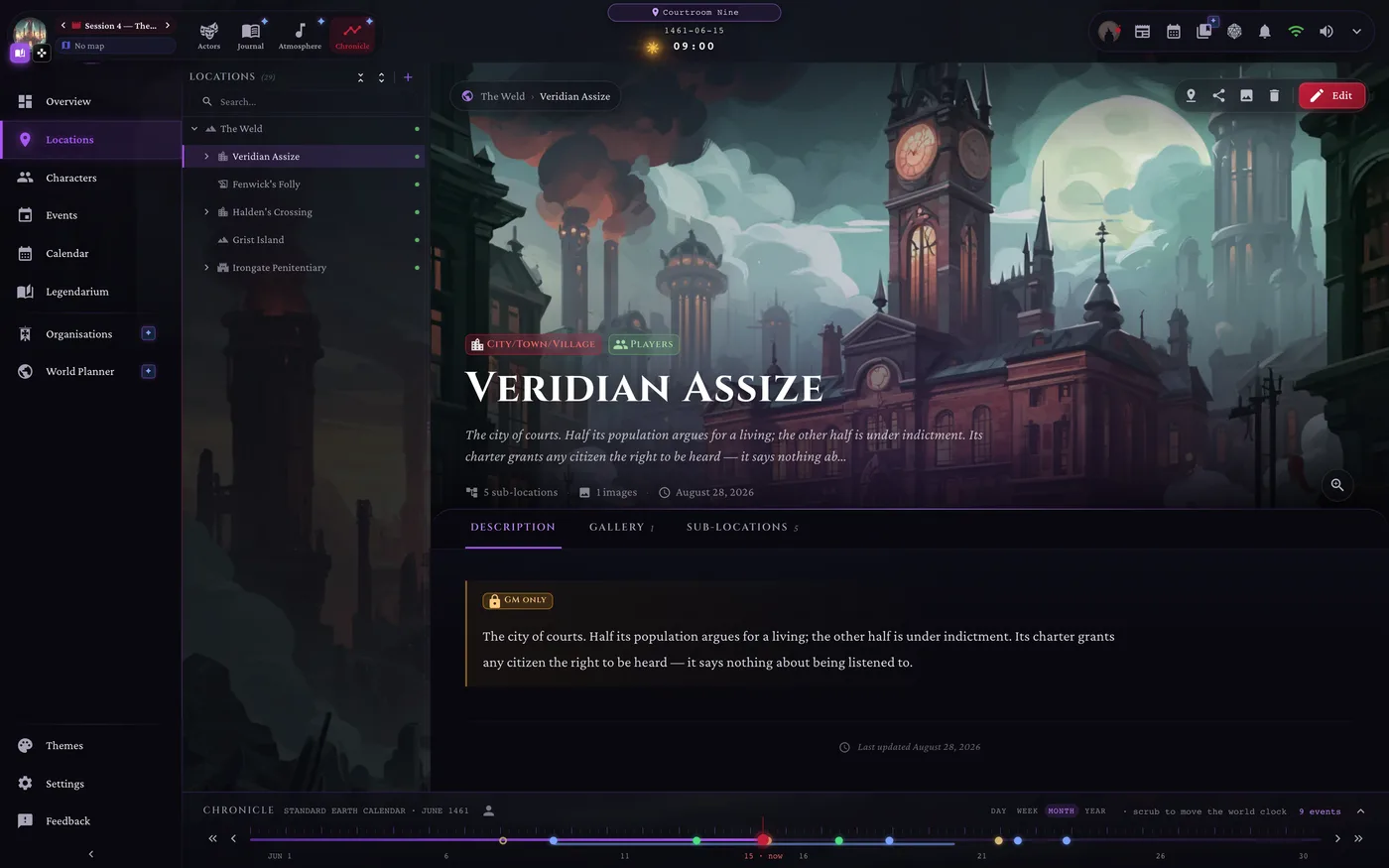
WorldMaster RPG is built around this workflow. The Legendarium is a campaign wiki where entries link to each other and to the places, people and factions of your world, and each account can carry a truth status and a teller. Locations nest from realms down to single rooms, history sits on a timeline in your own calendar, and every description section has its own visibility, so players read only what their characters know. You can import existing Markdown notes, including [[wikilinks]], and export your lore back to Markdown at any time.
Frequently asked questions
What is a lore bible?
A lore bible is the single reference for your world: its places, people, factions, history and rules, kept consistent so every story set there agrees. For a game, it works best as linked entries rather than one long document.
How long should a lore entry be?
Short enough to read at the table. Lead with one or two sentences someone in the world could say, then add detail below. Most entries need a paragraph or two; split anything longer into linked entries.
Should I use Obsidian or a dedicated worldbuilding tool?
Obsidian is excellent for private notes and is free and local, but player access, secrets and play tools come from plugins you assemble yourself. A dedicated tool such as WorldMaster RPG adds shared lore, per-section secrets and live play out of the box, and can import your Markdown notes.
How do I share lore with my players without spoilers?
Split each entry into public and secret sections and reveal sections as the party discovers them. Players then read the world as their characters know it.